TecAlliance PIM integration for auto parts
One system that manages supplier price lists, downloads TecAlliance data, and pushes to Shopify, eBay, Magento, Google Shopping and Linnworks.
The brief.
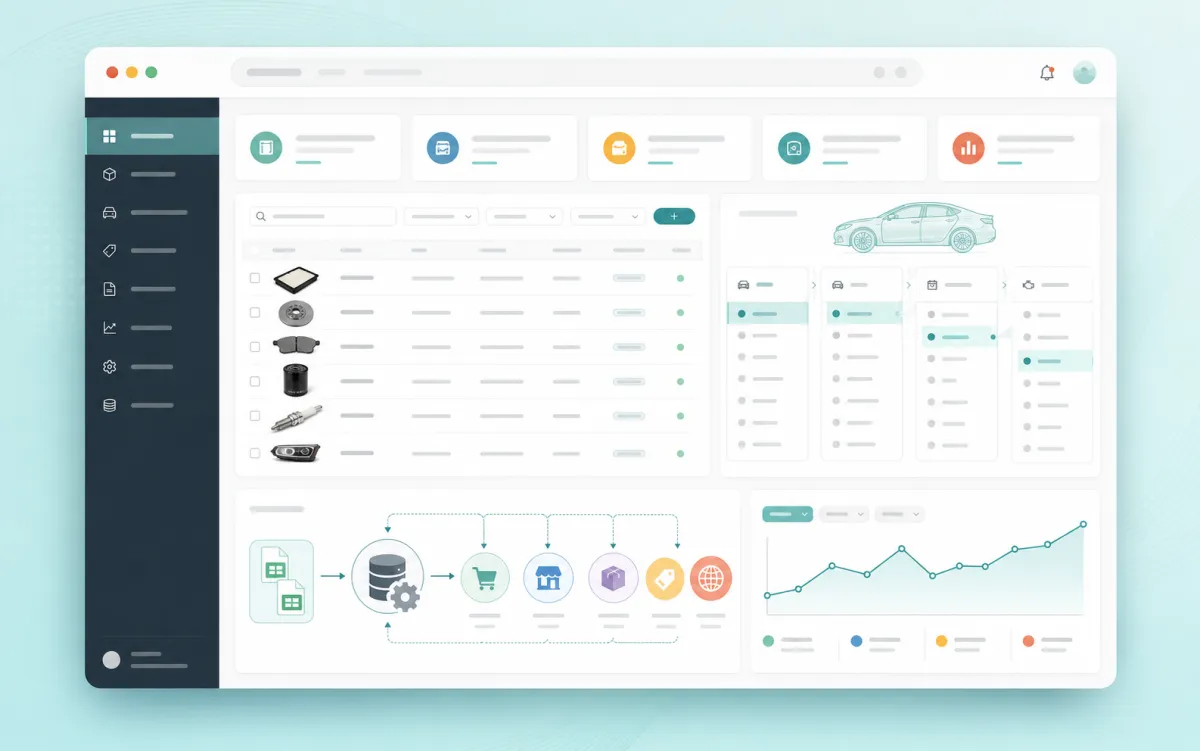
Auto parts is the hardest cataloguing problem in ecommerce. A brake pad is not a product — it is a part number, a set of OE cross-references, a list of every make, model and engine it fits, and a different listing format on every channel you sell through. The industry answer to that data problem is TecDoc, TecAlliance's global parts catalogue — but a TecDoc licence on its own is just an API key. Run Auto Parts had outgrown the first PIM I built them: supplier price lists arrived as spreadsheets, fitment lived in TecDoc, pricing rules lived in people's heads, and every sales channel wanted the same product described a different way. CPS2 is the second-generation system — a purpose-built automotive PIM that does four things: manages supplier price lists, downloads data from TecAlliance, pushes to every sales channel, and generates the reports the business runs on.
Price lists in, TecAlliance data down.
The pipeline starts with supplier price lists. CPS2 ingests them in whatever shape each supplier sends — CSV or Excel, with configurable column mapping per supplier — and manages the full lifecycle: cost prices, stock sources, supersessions, and repeat imports that update rather than duplicate. Each product is then matched to its TecDoc article and CPS2 downloads the data from TecAlliance: vehicle fitment by K-Type, OE and OEM cross-references, trade numbers, technical specifications, images and PDFs — around a thousand products per run, on a schedule, with response caching so the TecAlliance API bill stays sane. The full Australian make–model–engine catalogue syncs from TecDoc too, and TecAlliance vehicle identification powers a rego-plate lookup on the storefront.
Pushed to every platform.
From that one enriched catalogue, CPS2 pushes to five platforms, each speaking its own dialect: Shopify through GraphQL bulk operations, eBay with EPID matching and listing reconciliation, Magento for the legacy storefront, Google Shopping via Merchant Center product feeds, and Linnworks for orders and inventory. Per-channel pricing rules mean each platform gets its own margins without anyone maintaining five price files. Sixteen dedicated job queues keep a stuck eBay sync from ever slowing a Shopify publish. The admin team list a part once; the channels take care of themselves.
Reports the business actually runs on.
CPS2 generates the reports purchasing decisions depend on — stock consumption, sale cycles, supplier cover, best sellers with missing data — straight from the same catalogue the channels publish from, so the numbers always agree. Staff can pull them from the admin panel, or ask in plain English through Claude via an MCP reporting server backed by a read-only reporting database with signed, expiring CSV exports.
One home for the business logic.
The real asset is centralisation. Pricing rules, supplier mappings, fitment logic, channel formatting, image standards — the complex business logic that used to live in spreadsheets, channel apps and institutional memory now lives in one system, versioned, tested and visible. When a rule changes, it changes once and every channel follows. Manual edits are tracked so automated enrichment never overwrites a human decision, and 100+ automated tests, static analysis and CI back every release.
What CPS2 does.
- 01Manages supplier price lists end to end — any CSV or Excel shape, configurable column mapping per supplier, repeat imports that update rather than duplicate
- 02Downloads data from TecAlliance: fitment by K-Type, OE cross-references, technical specs, images and PDFs, matched to TecDoc articles automatically
- 03Pushes to Shopify, eBay, Magento, Google Shopping and Linnworks from a single source of truth, with per-channel pricing rules
- 04Generates purchasing reports — stock consumption, sale cycles, supplier cover — queryable in plain English through Claude
- 05Centralises the business logic: pricing, mappings and channel rules live in one tested, versioned system
- 06Generates product descriptions with AI agents and flags watermarked supplier images before they go live
AI where it earns its keep.
CPS2 uses AI as infrastructure, not garnish. Specialist agents write product descriptions and brand copy against the enriched TecDoc data, and an image agent detects supplier watermarks before a listing embarrasses anyone. Because the business logic and the data live in one system, the AI works against the same source of truth as everything else — no dashboards to learn, no SQL to write.
Need a TecDoc integration of your own?.
Every parts retailer has this problem: a TecDoc or TecAlliance licence on one side, supplier spreadsheets on the other, and channels that each want their own format. CPS2 is proof the whole pipeline can be one system. The architecture — price list management, TecAlliance data download, multi-channel publishing, reporting — is repeatable for any automotive catalogue, in Australia or anywhere TecDoc reaches. If you hold a TecAlliance data licence and it is not earning its keep, that is exactly the brief I built CPS2 for.