Run Auto Parts: a parts catalogue that finally fits
An Australian auto parts retailer rebuilt around fitment, suppliers and speed.
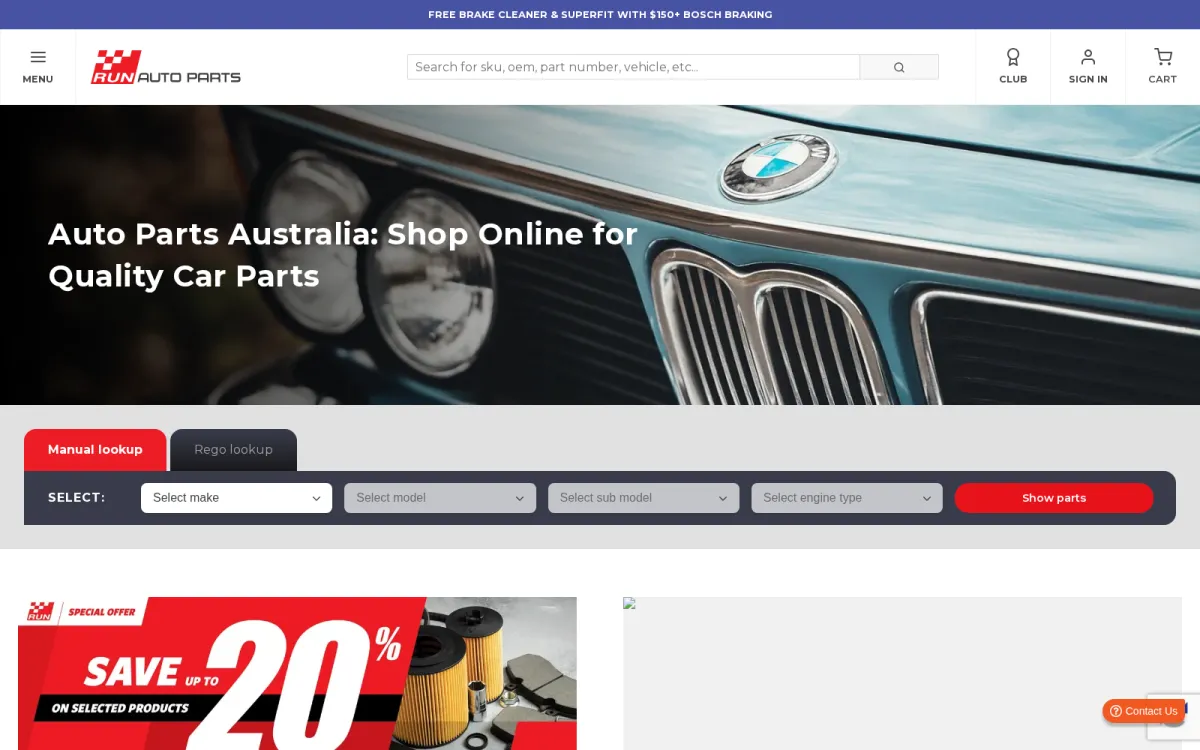
The brief.
Run Auto Parts sells to Australians who know exactly what they need, and plenty who don't. The old Magento 1 site couldn't hold the catalogue, the admin team were listing new products by hand across several sales channels, and the fitment data the whole business ran on was scattered between supplier APIs and spreadsheets. They needed a single source of truth, a storefront that could filter deeply without slowing down, and a way to list a part once and have it appear everywhere.
Approach.
I split the problem into three layers. A Laravel middleware took the supplier APIs, normalised them into consistent product records, and fed a custom PIM built for the people who actually do the listing. Magento 2 handled commerce and order flow. The storefront itself was rebuilt in Next.js with Algolia carrying the search and filter load, because Magento's native layered navigation was never going to hold the shape of an auto-parts catalogue. Linnworks stayed as the order hub and was wired into the new stack rather than worked around it.
What I shipped.
- 01Magento 1 to Magento 2 migration with URLs, SEO and order history preserved
- 02Custom PIM for the admin team, sitting in front of a dozen supplier feeds
- 03Laravel middleware for ingesting, normalising and publishing supplier product data
- 04Next.js storefront with Algolia-powered fitment search on year, make, model and variant
- 05Linnworks wired into the new stack for orders, inventory and multi-channel listing
- 06List-once publishing from the PIM out to every sales channel the business sold through
- 07Coordinated release cadence with Run Auto Parts' external marketing and design contractors
“We used to list a product by hand in four places. Now it goes in once and is live everywhere by lunchtime.”
Outcome.
The catalogue holds together. Fitment search is fast enough to feel instant, even on the deepest categories. The admin team list new products in a fraction of the time they used to, and the supplier feeds they could never quite trust now feed a PIM they can. Magento 2, the Next.js storefront, the Linnworks hub and the PIM all run as parts of one system rather than four things lashed together.
The lesson.
An auto-parts site stands or falls on fitment. Get the data clean and the filter fast, and the rest of the business starts to follow.